
Commercial and industrial properties need perimeter fencing that matches their security risks, operating requirements, and available budgets. Chain link suits lower-risk sites where affordability and boundary control matter most. Steel palisade provides a more imposing physical deterrent for industrial yards and storage facilities. Anti-climb mesh offers another option for sites that require restricted access, clear visibility, and greater resistance to climbing.
Choosing the right system starts with identifying what the perimeter must protect. Businesses planning security upgrades can explore strong barriers designed for commercial and industrial properties. The final choice should reflect the site’s layout, potential threats, installation costs, and ongoing maintenance needs.
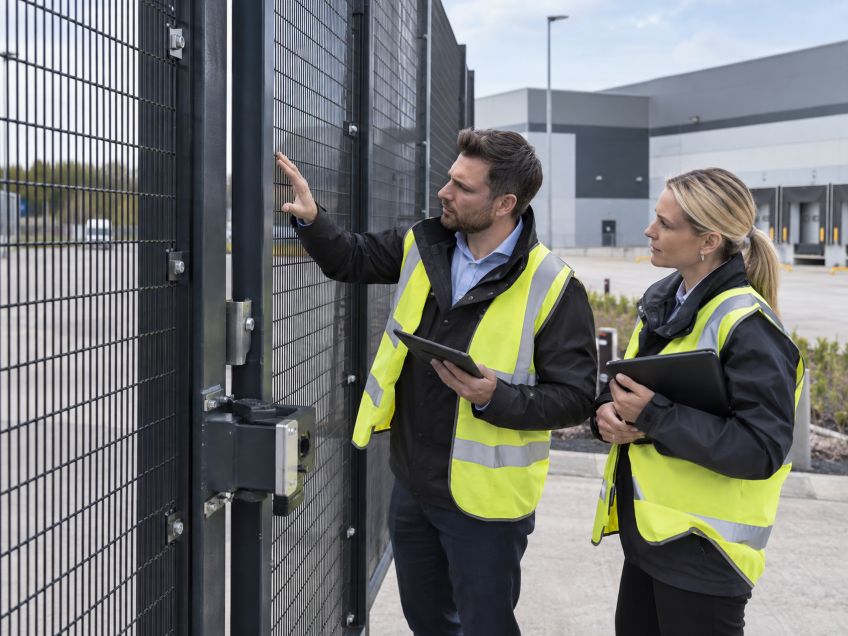
Steel Palisade: A Visible Deterrent for Industrial Sites
Steel palisade fencing uses vertical steel pales attached to horizontal rails. Its rigid construction and pointed or rounded tops create a clearly defined boundary. It is commonly considered for warehouses, equipment yards, utility facilities, and other sites where restricting access is important.
The UK’s National Protective Security Authority (NPSA) recommends a minimum panel height of 2.4 metres for security fencing, increasing to at least 3 metres for higher-security applications. These recommendations provide useful design benchmarks, although actual requirements depend on the site’s risk assessment.
Where Does Palisade Perform Well?
Palisade fencing provides a physical obstacle that can discourage casual climbing. Its vertical construction offers fewer convenient footholds than conventional chain link. Heavy-duty pales and secure fixings can also increase resistance to attempts to force an opening.
However, performance depends on steel thickness, pale spacing, rail connections, and installation quality. Wider gaps offer relatively clear views through the fence, although the vertical bars can interrupt camera sightlines.
Upfront costs are generally higher than basic chain link because of material weight and installation requirements. Individual pales may be replaceable, which can simplify certain repairs.
Anti-Climb Mesh: Security Without Blocking Visibility
Anti-climb mesh fencing uses tightly spaced welded steel wires to create a rigid panel. The small openings make it difficult to establish handholds or footholds. They also restrict access for many commonly used cutting tools.
This design can suit logistics centres, distribution facilities, data centres, and commercial premises that require both perimeter protection and visual monitoring.
What Makes Small-Aperture Mesh Different?
Unlike conventional chain link, closely spaced welded mesh limits the opportunities available for climbing. Its continuous surface also provides clear sightlines for security personnel and surveillance cameras.
The NPSA identifies fencing, surveillance, and intrusion detection as complementary parts of perimeter protection. Mesh can support this approach when cameras need an unobstructed view of activity near the boundary.
Security mesh is available in different heights and wire configurations. Panels around 2.4 metres suit many commercial applications, while taller systems can be specified for more demanding sites.
Its main drawback is cost. Dense welded panels, specialised fixings, and suitable foundations can increase the initial investment. Damaged sections may also require replacing an entire panel rather than individual wires.
Why Chain Link Still Matters for Large Properties
Chain link fencing uses interwoven steel wire to form a flexible diamond-shaped mesh. It remains a practical option for extensive commercial boundaries, storage areas, and locations where access control matters more than resistance to determined intrusion.
Its greatest advantage is affordability. Relatively simple materials and installation methods can make chain link suitable for businesses securing long perimeter runs.
The ASTM International F2611-23 guide addresses the design and construction of chain link security fencing. It covers materials, frameworks, fittings, gates, and installation considerations intended to increase intrusion resistance.
Where Does Chain Link Fall Short?
Standard diamond-shaped openings can provide convenient handholds and footholds. Conventional wire fabric may also be vulnerable to cutting, depending on wire diameter and available tools.
Height, heavier wire, reinforced frames, and suitable toppings can improve performance. However, these additions increase costs and may reduce the initial price advantage.
Chain link offers good visibility through its open structure. Heights commonly range from approximately 1.8 to 3 metres for commercial installations, although other specifications are available.
For higher-risk sites, the NPSA does not recommend chain link fabric as its preferred security fencing material.
How Should Site Managers Compare Compliance and Costs?
Fence selection should consider the complete installed system rather than panel prices alone. Posts, foundations, gates, coatings, site conditions, and labour can significantly affect project costs. The choice between standard fencing panels and customized security systems also reflects the broader purchasing considerations discussed in premade or personalized solutions. Standard configurations may help control initial expenses, while tailored designs can address specific security risks, site dimensions, and access requirements.
Relevant standards also vary by location and intended application. The NPSA references BS 1722 specifications for security fencing, while ASTM International provides guidance on chain link construction and testing fence resistance.
Compliance with a material specification does not automatically establish a particular security rating. Site managers should request documented test results where resistance to forced entry is required.
A Practical Decision Guide
- Choose chain link when budgets are limited and the main objective is defining a lower-risk boundary.
- Consider palisade where visible deterrence, rigid construction, and industrial durability are priorities.
- Consider anti-climb mesh where climbing resistance and clear surveillance views are important.
- Check applicable standards, gate security, installation quality, and maintenance requirements before approving a system.
The most suitable perimeter solution depends on the threats facing each property. A risk assessment, supported by appropriate specifications and independent testing where necessary, can help managers balance protection, visibility, and long-term expenditure.